Continuing Healthcare (over 18 years old)
WellChild and Irwin Mitchell have worked in partnership on this article, in which we guide families through the Continuing Healthcare system and outline what help is available for those with significant healthcare needs.

This article has been created by Eleanor Swain, Solicitor at Irwin Mitchell. If you have any queries you can get in touch with Eleanor by email at [email protected] or call 0370 1500 100 Extension: 3569
WellChild and Irwin Mitchell share a vision to help build stronger communities. We have teamed up to create a legal section for the WellChild Information Hub. This article on Continuing Healthcare is part of a series of legal articles aimed at families with children who have complex medical needs.
Navigating long-term health and care support can feel overwhelming, especially when you’re unsure what help is available or who is responsible for providing it. This article explains what Continuing Healthcare is, who may be eligible, how assessments work, and what support might look like in practice. If you’re exploring care options for yourself or someone you support, this guide will help you understand the essentials and what to expect from the CHC process.
What is Continuing Healthcare?
Continuing Healthcare, also known as (CHC) is NHS healthcare funding provided by Integrated Care Boards (ICBs) in England and Health Boards (UHBs) in Wales.
For children and young people up to the age of 17, please see our article on Children’s Continuing Healthcare by clicking on the link below.
Who Is Eligible?
Individuals are eligible for continuing healthcare funding if:
- They have an overall primary healthcare need, requiring an elevated level of health interventions and treatments
- Their care needs are assessed as complex, intense or unpredictable
- Their care needs are over and above the care that is usually provided to those residing in a care home
However, continuing healthcare funding can also be provided to clients living and receiving care at home.
What is a Primary Healthcare Need?
A primary healthcare need means someone needs help with treating, managing, or preventing illnesses, injuries, or disabilities, as well as care and recovery after these health problems.
How Does This Differ From a Social Care Need?
A social care need focuses on providing support for daily living activities. This includes:
- Personal care
- Assistance with social interactions and activities
- Meal provisions
Who is Responsible for Continuing Healthcare?
The body responsible for Continuing Healthcare differs depending on which area of the UK you live in. Click on each of the orange boxes to find out who is responsible in your region.
The Integrated Care Boards (ICB) are the bodies which assess and fund continuing healthcare in England.
The University Health Boards (UHB) are the bodies which assess and fund continuing healthcare in Wales.
Continuing Care in Northern Ireland is slightly different to in England and Wales.
The NHS in Scotland has replaced continuing healthcare with a scheme called Hospital Based Complex Clinical Care.
The National Framework is the main guidance document for assisting individuals and assessors with CHC assessments and appeals. You can view the National Framework here.
Application Process
An individual who is thought to have a primary healthcare need should have a screening assessment called a pre-assessment checklist.
An individual who is thought to have a primary healthcare need should have a screening assessment called a pre-assessment checklist.
The pre-assessment checklist can be requested by:
- The individual
- Family members
- Staff
- Sometimes social workers will help you with making this request.
Requests are made via the local ICB/UHB or a nurse.
The pre‑assessment checklist is used to identify whether someone has a high enough level of need to move on to the next stage of the Continuing Healthcare (CHC) assessment, which is the Decision Support Tool (DST).
The checklist is designed with a low threshold, meaning many people will pass it and go on to the full DST assessment. If a person does not meet this threshold, and the checklist has been completed correctly by the Integrated Care Board (ICB), it is unlikely they would be found eligible for CHC funding through the DST.
Therefore, if you do not pass the checklist, the assessment will not continue to the DST stage.
You can appeal the checklist result if you think it is wrong in the same way as the DST. Click here to read our article about appealing continuing care decisions.
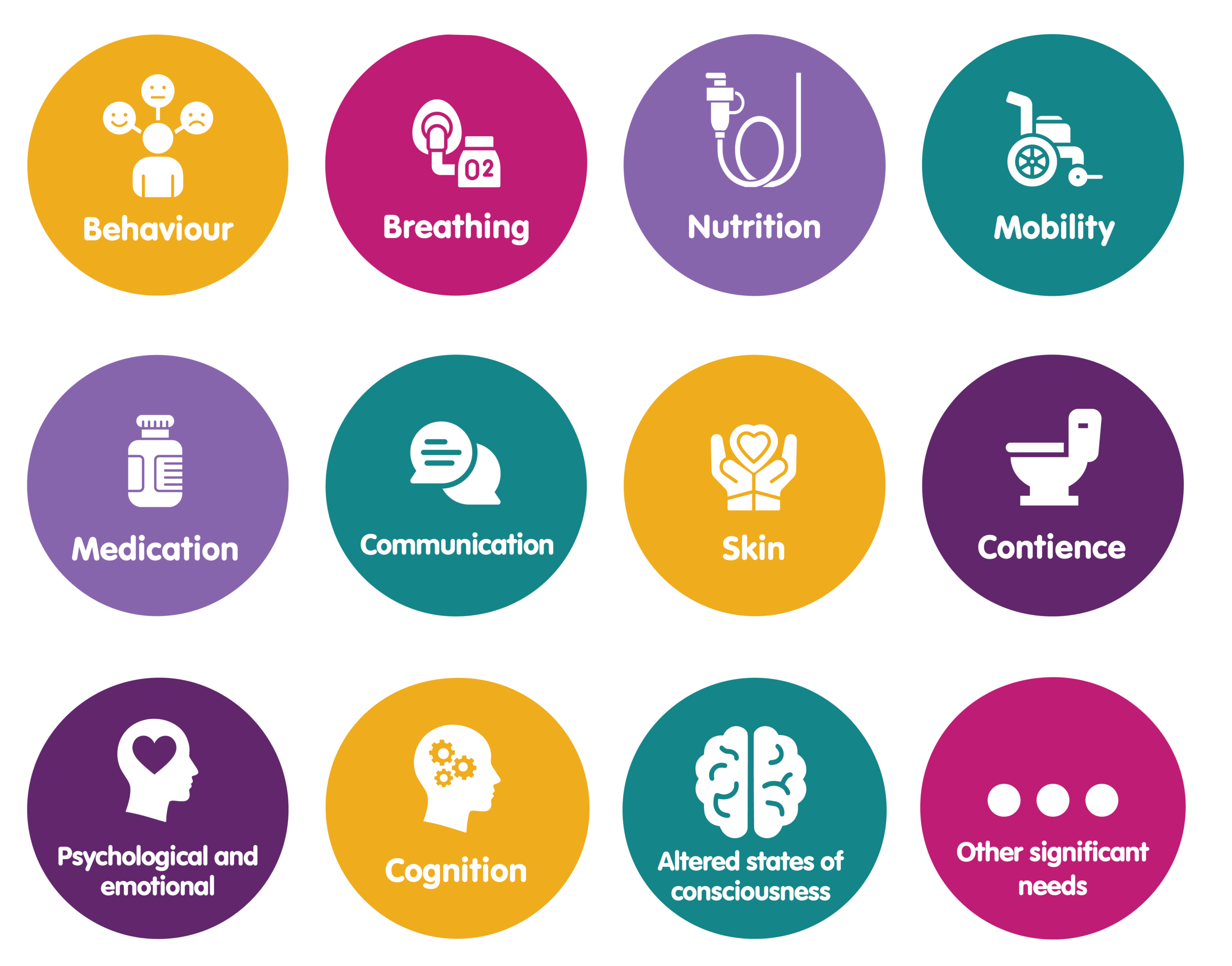
The DST is the main assessing tool for considering whether someone is eligible for CHC funding and focuses on 12 domains as well as considering whether the individual has complex, intense or unpredictable healthcare needs and is eligible for CHC funding.
There are specific descriptions related to the 12 domains. It is important to consider a need against these descriptions. You can appeal a level of need awarded under these domains but remember that the description is what the level of need is based on.
The domains are breathing, nutrition, continence, skin, mobility, communication, psychological and emotional, cognition, behaviour, medication, altered states of consciousness and other significant needs.
Example
For example, for a low award in Nutrition the descriptor is:
Needs supervision, prompting with meals, or may need feeding and/or a special diet (for example to manage food intolerances/allergies).
OR
Able to take food and drink by mouth but requires additional/supplementary feeding.
The process for NHS Continuing Healthcare assessments can be complex. Beacon is an independent organisation that offers free, expert advice on NHS Continuing Healthcare.
You can click here to visit the Beacon website or call their free helpline on 0345 548 0300 for support.
How Eligibility Is Decided
Automatic Eligibility
Someone is automatically eligible if they are assessed as having:
- A priority level in one starred domain, or
- Severe levels of need in two domains
However, if the scores are, for example, a severe and high levels of need, the next stage of the assessment is to consider whether or not they have a primary health need.
Primary Health Needs Approach
The Primary Health Needs Approach (PHNA) discusses how complex, intense and unpredictable a need is as well as discussing the nature of these healthcare needs.
The PHNA allows the assessor to analyse and consider the interrelations of the care and care needs, complexity and intensity of the same and any unpredictable care needs.
If you are found to have one of these then you will be eligible for Continuing Healthcare Funding.
Click on each of the yellow boxes to find out more about what each of these descriptors means.
Nature describes the particular characteristics of an individual’s needs.
It can include physical, mental health, or psychological needs, and the type of those needs.
It also describes the overall effect of those needs on the individual. This includes the type (‘quality’) of interventions required to manage them.
Intensity relates to the:
- Extent (‘quantity’) of the needs
- Severity (degree) of the needs
- Support required to meet these needs
This includes the need for sustained/on-going care (‘continuity’).
Complexity is about how the needs present and interact to increase the skill required to monitor the symptoms, treat the condition(s) and/or manage the care.
This may arise with a single condition, or it could include the presence of multiple conditions or the interactions between two or more conditions.
It may also include situations where an individual’s response to their own condition has an impact on their overall needs. For example, when a physical health need results in the individual developing a mental health need.
Unpredictability describes the degree to which needs fluctuate. This is because fluctuation create challenges in managing the needs.
It also relates to the level of risk to the individual’s health if adequate and timely care is not provided.
An individual with an unpredictable healthcare need is likely to have either a fluctuating, unstable or rapidly deteriorating condition.
CHC Funding In The Community
What is CHC Funding in the Community?
CHC funding can be provided in the community. If this is the case, the CHC funding will cover the:
- Nurses
- Heath Care Assistant carers required to meet the healthcare needs assessed in the DST
How Many Hours Do You Get?
Once you have been awarded eligibility for CHC funding, the ICB/UHB will consider how many hours of care support the person requires to meet their needs in the community. This should be a person-centred approach and are required to meet the needs of that person.
The CHC teams do sometimes use a computer tool to calculate how many hours should be provided to meet need, but this needs to be considered by the assessor to ensure that they would meet need.
Only the care the CHC team agrees the person requires would be paid for by the CHC team.
What If Enough Hours are Not Awarded
It is a legal requirement for the CHC teams to ensure that they are providing sufficient hours to meet the care needs of a person. If the hours calculated do not meet these needs, a challenge should be made, providing the CHC team with evidence that further hours are required. You can see more about making a challenge for a CHC package in the community here.
Management of Continuing Healthcare Packages in the Community
These packages can be managed by:
- The CHC team
- The person themselves
- Someone who is known to the assessed
The CHC team will provide a Personal Health Budget which will be a sum of money the CHC team has assessed would be required to meet needs.
This budget can then be managed in three different ways:
- Notional budget: the CHC team commissions the care directly.
- Third Party Budget: an independent company hold the budget and commission the care as per the agreed care plan
- Direct payments: the budget goes to the person or relative and they manage the care, commission the care via an agency or employ carers themselves. However, this budget also needs to cover training, payroll etc.
The direct payments allow a more flexible approach to care, however, comes with its own issues. Click on the yellow boxes to see considerations about rates and top-up.
The major aspect of concern to those with CHC is the increase of private agency rates and the rates being much higher than what the NHS employed staff rates are.
The CHC budget will be based on NHS rates and therefore could be lower than what a private agency is requesting. This needs to be discussed with the CHC team, however, you will need to consider what the local agency rates are and whether you are able to find a care team that will work at NHS rates.
The NHS have a duty to ensure that public funds are spent reasonably, including ensuring that if a cheaper option is available that can still meet the needs of the assessed, they should be using the cheaper option.
However, if there are no agencies at NHS rates that can meet meets, the NHS team should be asked to increase the budget to pay for the agencies that can meet need. You will need to look into other agencies and find out whether they can meet the needs assessed.
If you are using an agency that has increased its rates, you need to tell the CHC team and you should consider whether there are any cheaper agencies that are able to provide this service and whether they should be used instead, otherwise, there is chance the budget will not cover the care costs being paid.
CHC funding is meant to fund your assessed needs and is NHS funding which is a free service. Therefore, the CHC team cannot ask you to top up a healthcare package that the CHC team should be implementing.
Appealing Your Decision
If you don’t think the decision you received was correct you can appeal it by contacting the Integrated Care Board (ICB)/ University Health Board (UHB).
The information in this article was correct at the time of publishing but may be subject to change
If you have any comments, ideas, or suggestions about this article don’t hesitate to get in touch with us at [email protected]
Please don’t forget to leave feedback on this article!
Elanor Swain, Solicitor
Rachel Carluke, Family Information Officer
First published: August 2026
Review due: August 2027