Home Education and Education Otherwise Than at School (EOTAS)
WellChild and Irwin Mitchell have worked in partnership on this article, which covers Elective Home Education (EHE) and Education Otherwise that at School (EOTAS).

This article has been created by Lauren Haines, Education Solicitor at Irwin Mitchell LLP. If you have any queries you can get in touch with Lauren by email: Lauren Haines [email protected], or call 01243 813170.
WellChild and Irwin Mitchell share a vision to help build stronger communities. We have teamed up to create a legal section for the WellChild Information Hub. This article on Home Education is part of a series of legal articles aimed at families with children who have complex medical needs.
This article will cover the rules around home educating your child; the difference between Elective Home Education (EHE) and Education Otherwise that at School (EOTAS); what home education should look like; information about how to get an EOTAS package; and what to do if your local authority refuses your request.
Can children be educated at home?
It is a common but inaccurate myth that home education (or home schooling) is illegal in the UK. As of October 2024, the UK government estimates that around 111,700 children are educated at home; a significant increase compared to pre-pandemic levels.
If you are the parent of a child of compulsory school age, you have a legal duty to ensure your child receives a suitable education. For most children, this education will be in a structured school setting, but that is not the case for all. A package of home education can still be considered a “suitable education”; in fact, for some pupils, it may be the only suitable education they can receive.
There are many circumstances where home education may be suitable for a child or young person, such as:
- Parents believe a flexible, more tailored education would be in their child’s best interests.
- The child is struggling to (or unable to) attend school due to health issues (including mental health difficulties).
- The child’s previous school placement has broken down, and a new placement has not yet been identified.
There are, however, a few exceptions to be aware of:
- If your child is subject to a School Attendance Order, they cannot be educated at home (full-time or part-time).
- If your child has an Education, Health and Care Plan (EHCP) that names a special school in Section I, you must seek permission from your local authority before removing your child from the school roll.
What is Elective Home Education (EHE)?
Elective Home Education (EHE) is the term used in England, Wales, and Northern Ireland, where parents choose to educate their child at home, rather than sending them to school full-time. In Scotland, it is more commonly called ‘Home Education’.
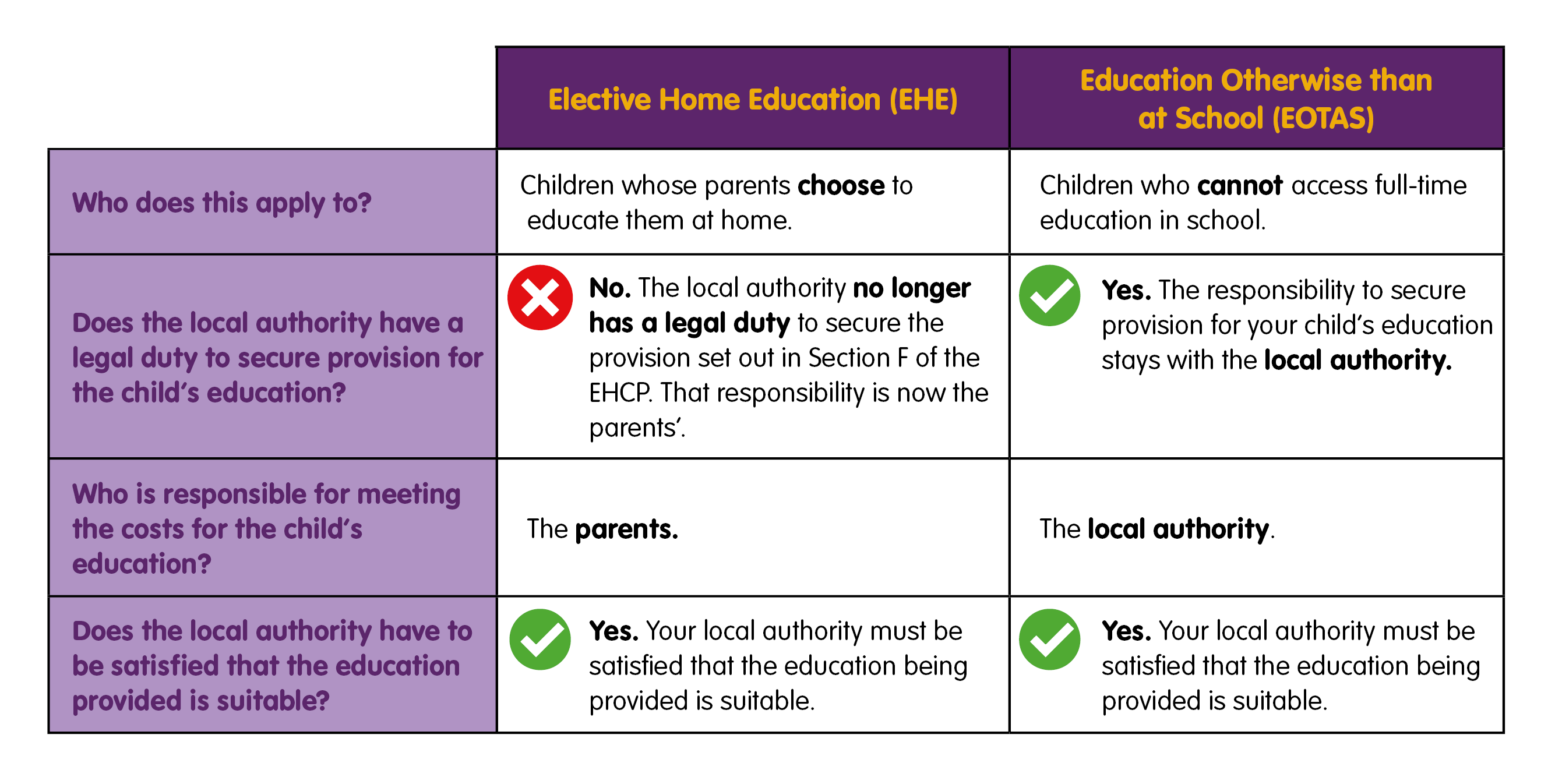
It is important to remember that EHE is a choice, rather than a necessity. If a parent decides that home education is the best option for their child, and they choose to remove their child from school to put a suitable package of home education in place, they are accepting responsibility for providing that education, and the local authority’s legal duties are reduced. The local authority still must be satisfied that the package of EHE is suitable, but it does not have any responsibility to provide or fund the EHE in place.
What if my child has an Education, Health, and Care Plan (EHCP)?
Your child may have an EHCP, but they can still be removed from school to receive a an EHE package. Legally, a local authority can only cease to maintain an EHCP when either:
- It is no longer responsible for the child or young person.
- It is no longer necessary for an EHCP to be maintained.
A local authority cannot cease to maintain an EHCP on the basis that the pupil is being electively educated at home. The local authority must still review the plan annually so that it can be satisfied that the arrangements in place are suitable, and that the pupil’s needs are still being met. The EHCP must still be kept up-to-date and relevant for the child or young person, and the local authority may still name a type of school in Section I that it believes would be suitable for the pupil, but the EHCP should state that parents have made their own arrangements.
However, the local authority no longer has a legal duty to secure the provision set out in Section F of the EHCP. That responsibility will now sit with the parents, so it is important to ensure that the package of EHE being put in place includes everything set out in Section F. If there are items of provision in Section F that are no longer applicable, or are not required to meet the child’s needs, the EHCP should be amended accordingly.
What is Education Otherwise than at/in School (EOTAS or EOTIS)?
Education Otherwise Than At School (or EOTAS, sometimes referred to as EOTIS) is another term that may be used to describe home education. The difference between EOTAS and EHE is that, where EHE refers to home education that has been chosen by parents as the best option for their child, EOTAS describes home education (or any education that takes place outside of a school setting) for pupils who cannot access full-time education in a school.
Under section 19 of the Education Act 1996, local authorities have a duty to make suitable educational arrangements for compulsory school-age pupils, who cannot receive a suitable education without those arrangements. Essentially, where it is not suitable for a child to attend school (for example, due to exclusion, illness, mental health difficulties, or on account of their special educational needs), the local authority must put in place an alternative package of education. With EOTAS, the responsibility to educate your child (and meet the costs of that education) stays with the local authority, rather than transferring to you.
What should home education (EHE or EOTAS) look like?
One benefit of home education – be that EHE or EOTAS – is that it can be flexible and tailored to the individual child’s specific needs.
For some children, that will be following the National Curriculum (or equivalent for pupils in Wales, Scotland and Northern Ireland), whereas for others, it will be a package of alternative support, perhaps with input from other therapists and experts (for example, Speech and Language Therapy and/or Occupational Therapy).
It is also possible to have a hybrid arrangement, where a child receives education at school part-time and home education for the remainder of the week. Schools and colleges will consider requests for hybrid arrangements on a case-by-case basis, but they have the right to refuse.
The main requirement, though, is that the education must be suitable. This means it must be:
- Full-time (or as close to full-time as is appropriate for the particular child).
- Efficient (i.e. achieving the outcomes it is intended to achieve).
- Suitable for the child’s specific age, needs, ability, and aptitude.
Your local authority must be satisfied that the education being provided is suitable. This requirement is the same for EHE and for EOTAS.
What is the difference between EHE and EOTAS?
The table below highlights the differences between Elective Home Education and Education Otherwise Than At School.
How do I request an EOTAS package?
If you believe your child requires a package of EOTAS, you will need to request this from your local authority. A good opportunity to do this is through your child’s EHCP annual review process. This should be brought forward if your child is no longer able to attend school (e.g. if their placement has broken down). The standard annual review timescales will apply. If the local authority agrees that EOTAS is required (either permanently or temporarily), the support provided should be specified in Section F.
Remember to make sure that the contents of Section F of your child’s EHCP is clear, detailed, specific, and (wherever possible) quantified. This is particularly important where your child is receiving EOTAS. For more details, see our guidance note on EHCPs here.
What might be included in an EOTAS package?
EOTAS can be truly bespoke. The big factors to keep in mind are that the provision must provide education or training to the pupil, and it must be reasonably required to meet the pupil’s special educational needs.
However, here are a couple of examples of what could be in a EOTAS package, depending on your child’s needs:
EOTAS can work really well for pupils who cannot access school for medical reasons. For example, for a pupil with complex needs who requires a high level of nursing care (over and above what could be provided by the vast majority of special schools), a package of EOTAS allows them to continue to receive educational input, whilst ensuring their medical needs are met in a safe environment.
For this type of child, an EOTAS package could include, but is not limited to:
- Daily tutoring sessions.
- Direct and indirect input from qualified therapists (including a Speech and Language Therapist, Occupational Therapist and Physiotherapist).
- Carefully supervised and planned educational trips into the community.
Equally, EOTAS can work well for pupils with mental health needs. For example, there are pupils who find attending a school placement so anxiety inducing that they simply do not have the capacity to access learning in that setting.
For those pupils, an EOTAS package might include:
- Tutoring sessions, but they may be shorter in duration or they may take place online, rather than in person, depending on the pupil needs.
- A part-time placement at a forest school, specialist mental health input etc.
It may also be that this EOTAS package is in place for a shorter amount of time overall, with the child transitioning back into a school placement when they are well enough to do so.
Please note: These are just examples of what could be in an EOTAS package. An EOTAS be entirely tailored to your child’s needs and will look different for every child.
If you are looking for some guidance about what package of EOTAS would be needed to meet your child’s special educational needs, you can seek input from an Educational Psychologist. This could be through statutory services undertaking a reassessment of your child’s needs (which you can request from the local authority), or it could be through a private Educational Psychology assessment.
Personal Education Budgets and EOTAS
Personal budgets can be very helpful for families of children with EHCPs, particularly if they are receiving an EOTAS package. A personal budget does not change what provision the child or young person will receive; it is about how that provision is arranged.
For most children with EHCPs, the local authority will secure the provision set out in Section F without the pupil or their family being directly involved. Often, the local authority provides funding to the pupil’s school or college placement, which then commissions the additional support needed. Sometimes, the local authority commissions this support directly, or provides it through statutory services (for example, through NHS Speech and Language Therapy teams). EOTAS packages can be delivered this way too.
A personal budget is an alternative way of commissioning the provision set out in an EHCP. With a personal budget, the local authority will calculate the costs of the provision and will provide that funding directly to a nominated person. This will normally be the young person themselves (if they are over 16), the pupil’s parents (for children under 16), or to a suitable alternative person of the parents’ or young person’s choosing. That nominated person then takes on the responsibility of commissioning the support and settling the costs from the funding provided in the personal budget.
There are advantages and disadvantages to a personal budget, these include:
Personal budgets gives the young person or parents a greater level of oversight and flexibility over:
- How the support is arranged.
- When the sessions are scheduled (provided the provision is delivered in line with the exact wording in Section F of the EHCP).
- Who delivers the provision.
The downside of personal budgets is that they are an additional level of responsibility for parents, and particularly for young people, to manage.
Local authorities will provide guidance, and arrangements will be reviewed regularly, but it is important that before confirming arrangements for a personal budget, the nominated person is fully aware of and happy with the duties and responsibilities expected of them.
They will need to:
- Keep copies of all receipts.
- Ensure personal budget funds are kept completely separate from other forms of funding.
- Ensure provision is delivered as set out in the EHCP.
You can find out more about personal budgets here.
What if the local authority refuses my request for EOTAS?
If your local authority refuses to put an EOTAS package in place, you can challenge that decision.
If your local authority issues a final EHCP naming a school placement in Section I, and you do not agree that this placement can meet your child’s needs, you can appeal against the contents of this EHCP to the First-tier Tribunal. Ensure you appeal against Section F of the EHCP, as this is the section that should set out the EOTAS package in place for your child. You can find out more information about appealing to the SEND first-tier Tribunal in our ECHP article.
Alternatively, if your child is out of education and the local authority is not putting any educational support in place, you can challenge this through a complaint to the local authority and, if required, through formal Judicial Review proceedings. These proceedings are complex so if you think this may be applicable to your child, and a complaint does not resolve matters, we recommend seeking legal advice.
See our article on Challenging Decisions for more information about making a complaint.
Are the rules around home education likely to change?
The Children’s Wellbeing and Schools Bill, introduced to Parliament on 17 December 2024, includes a number of proposed changes to the rules and regulations governing education and children’s social care in England and Wales. Among these proposed changes is the creation of a formal register of children not in school; if passed, it will require local authorities to maintain a register of all children being educated outside of school.
This would apply to England only, so parents of children in Wales, Scotland and Northern Ireland would see no changes to the current arrangements.
Further resources
The following resources provide further details on EHE, EOTAS, and other considerations for parents looking to educate their child at home:
The information in this article was correct at the time of publishing but may be subject to change
If you have any comments, ideas, or suggestions about this article don’t hesitate to get in touch with us at [email protected].
Please don’t forget to leave feedback on this article!
Lauren Haines, Education Solicitor at Irwin Mitchell
Rachel Carluke, Family Information Officer
First published: March 2025
Review due: March 2026